|
|
|
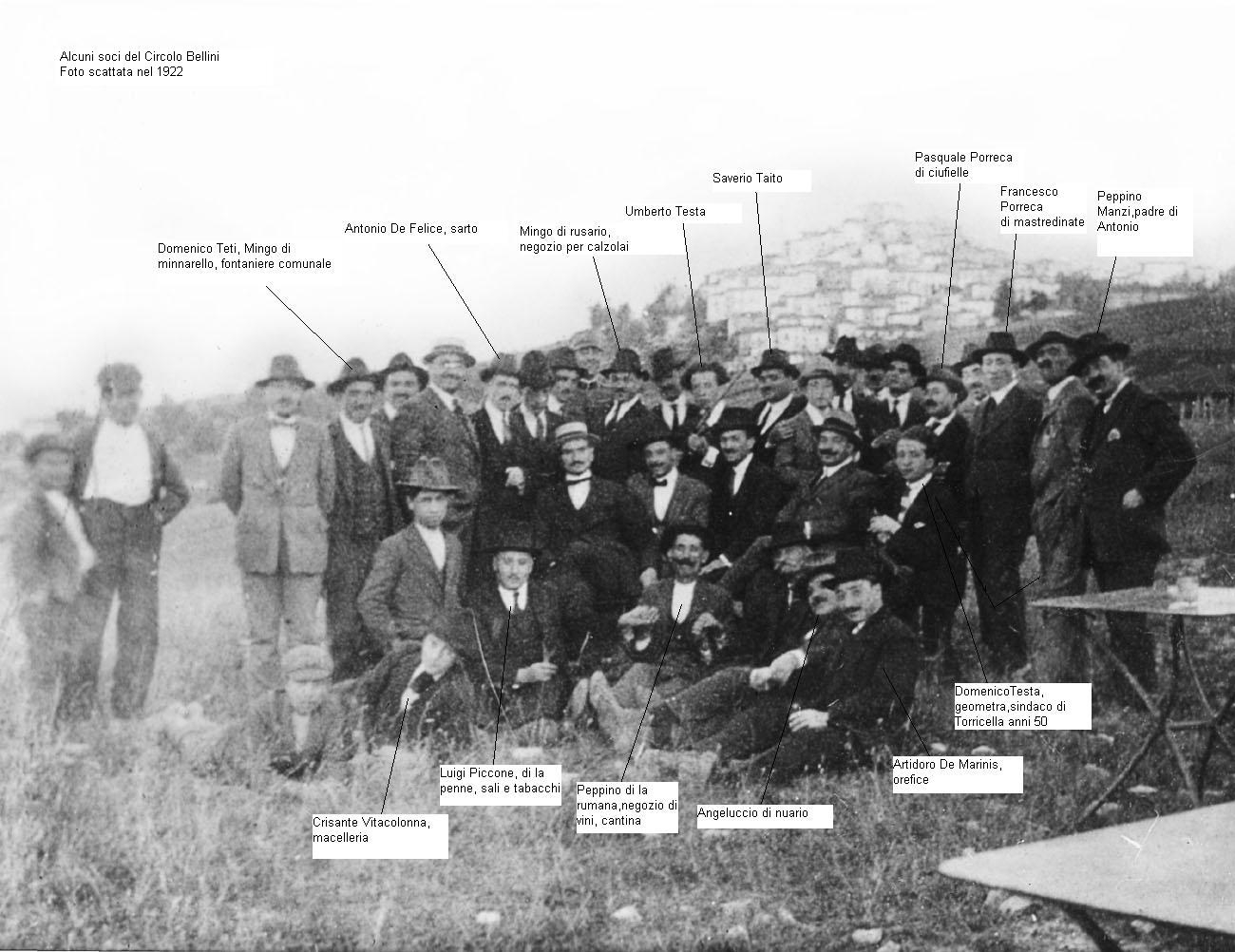
Fontaniere comunale = Town plumber. |
Associazioni - Associations
|
Circolo Bellini - 1922 e Soci della Casa di Conversazione - 1917 di Antonio Piccoli (Torricella, giugno 2005) |
Bellini Club - 1922 and the members of the “Conversation Club” -1917 by Antonio Piccoli (Torricella, June 2005) |
|---|---|
|
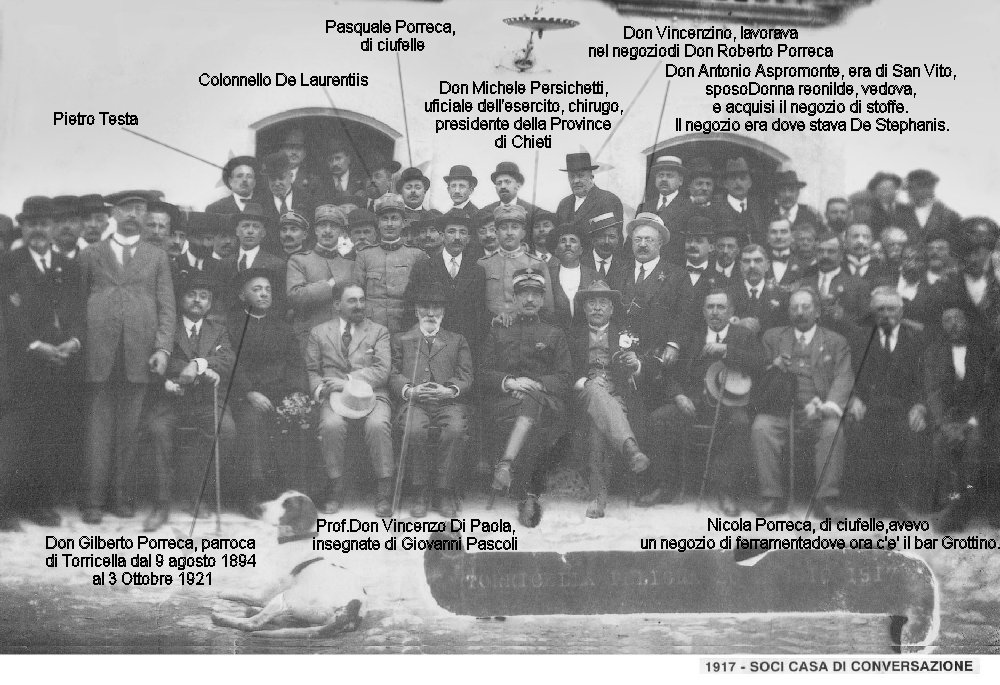
Avevo due fotografie di gruppi di persone, una del 1917 dei soci della Casa di Conversazione in posa davanti ai locali di Porreca Gilberto e l’altra del 1922 del Circolo Bellini , un altro gruppo di uomini fotografati a Sant’Antonio, in aperta campagna. Volevo tentare di dare i nomi a quei volti a me sconosciuti e così ho cercato di parlare con piu persone possibili di età avanzata. Pian piano, con verifiche incrociate, insieme abbiamo riconosciuto molti uomini i cui nomi risuonavano anche alle mie orecchie per averli qualche volta sentito parlare. Sicuramente erano quelli piu in vista oppure quelli che erano vissuti piu a lungo.. Certo sono passati 80 anni e quelli che piu o meno ricordano cominciano a scarseggiare. Peccato che questa ricerca è cominciata solo da poco tempo, forse già 5 anni fa il lavoro sarebbe stato più semplice. Fra un pò nessuno ricorderà piu niente di quegli anni. Per fare un viaggio a ritroso per prima cosa è consigliabile andare a leggere i due articoli pubblicati su “ Amici di Torricella”, quello di Ida Fadelli intitolato “nel millenovecentodiciannove” e quello di Gianni Materazzo intitolato “Il merlo del paese”. Basta andare sul sito e cliccare sugli Amici di Torricella, vi sono molti articoli del giornale, pubblicato fra il 1988 e 1994 , anche tradotti in inglese, fra cui questi due dove si dipinge la vita di quegli anni. Torricella contava circa 6.000 abitanti, c’erano molti negozi di stoffe e altri di ferramenta, c’erano 4 banche di cui una privata, la Cassa Agraria, fatta da due persone benestanti di Torricella. Il paese di oggi è piccola cosa rispetto a quello di cento anni fa. Era il centro commerciale di tutta la zona. A Torricella venivano da Pizzoferrato, Gamberale, Montenero, Colledimacine, Gessopalena e dagli altri paesi del circondario sia per comprare al minuto e sia per comprare all’ingrosso . A Torricella c’era la pretura, il carcere, il comando dei carabinieri, le scuole medie, il notaio, la farmacia, c’era anche un gestore dell’energia elettrica per Torricella e tutto il circondario, il frantoio ed il mulino, proprio come un grosso centro commerciale e agricolo. Ed a quel che sembra c’era anche una intensa vita associativa e culturale. Vi erano due circoli per il tempo libero , il primo “La casa di Conversazione” i cui iscritti appartenevano alla classe più agiata, la borghesia formata dai notabili, dai laureati e dai commercianti più ricchi. La sede, secondo alcuni, era nei locali dell’attuale Snack Bar, mentre secondo altri, come la signora Ida Fadelli, stava sotto casa sua che, dalla descrizione che ne fa lei, doveva essere la casa dei Persichetti, che sta di fronte allo Snack bar. In verità la foto del gruppo fotografato nel 1917 è stata scattata poco più su della casa dei Persichetti, davanti al negozio di alimentari che tempo fa era di Gilberto Porreca, quindi vicino alla sede sociale. Nei locali dello Snack bar invece c’era il negozio di Calzone , forse il piu grosso negozio della Torricella di allora. Vendeva di tutto, in particolare le stoffe. Può darsi comunque che abbiano ragione entrambi perché nel frattempo vi fu “la rivoluzione” del 1919, descritta nell’articolo di Gianni Materazzo. Essa fu fatta sull’onda della rivoluzione di ottobre e le gesta dei bolscevici, da alcuni reduci della guerra del 15-18 uniti ai contadini poveri e affamati. Questi “rivoluzionari” combinaro grande scompiglio tanto che furono chiamati i rinforzi da Casoli e da Lama per sedare la sommossa. Fra l’altro assalirono tutti i negozi presenti a Torricella e proprio il negozio di Calzone ebbe la peggio tanto che avendo tutta la merce distrutta e rubata, non riaprì più. Pertanto potrebbe essere che dopo questi fatti incresciosi, il circolo si trasferì nel palazzo di fronte, con i locali piu grandi e confortevoli. L’altro circolo era chiamato il “Circolo Bellini” . i soci appartenevano alla classe dei commercianti e degli artigiani e per lo più pare di idee socialiste. La sede era nei locali a piano terra della casa di “Mastridenate”, la casa natale di Vincevo Bellini senior. In tutti e due i circoli c’era un piccolo bar, la sala con il biliardo e la sala delle riunioni dove normalmente si giocava a carte. In verità il “Circolo Bellini” prima del 1922 si chiamava “Circolo della Rimembranza” ma siccome questo nome si rifaceva ai moti risorgimentali, per non avere problemi con i fascisti si cambiò in un più anonimo “Circolo Bellini”. I soci fondatori del Circolo Bellini furono 10, di essi si ricordano Antonio Porreca, l’ideatore della Pineta, Artidoro De Marinis, Peppino de la rumana, Peppino di ciufielle, Luigi Piccone de la penna, Peppino Manzi, Quirino De Laurentiis. Ambedue i circoli erano esclusivi e per entrare si doveva essere accettati . Le donne entravano solo in occasione delle feste organizzate, a natale o in qualche occasione particolare. Le foto dei gruppi dei due circoli, ma in particolare quello della “Casa di conversazione”, dà una immagine di come la vita a Torricella per alcuni fosse alquanto agiata. Basta guardare come erano vestiti per capire il livello di agiatezza. Anche i signori del “Circolo Bellini” sono a loro modo eleganti e vestiti bene e sono ritratti in occasione di una festa di campagna, la località dovrebbe essere il Tiro a segno. Secondo alcuni la foto dei signori della Casa di conversazione fu scattata in occasione del ritorno in licenza di alcuni ufficiali e sottoufficiali dell’esercito italiano. |
I had these two photos showing groups of people, one from 1917 with the members of the “Conversation Club” grouped in front of Gilberto Porreca’s premises and the second from 1922 of the “Bellini Club” which shows a group of men photographed at Sant’Antonio’s in the open countryside. I wanted to try and put names to the faces as these were unknown to me and so I tried speaking to as many elderly people as possible. Very slowly, with cross-checking, we managed to recognise many of the men, whose names resounded even in my ears because I had sometimes heard tell of them. Certainly they were the most well-known, or else those who had lived the longest. Of course 80 years have gone by and people who can remember that far back are beginning to be few and far between. It is a pity that this research was only begun recently, maybe even 5 years ago the work would have been much easier. Soon there will not be anyone who remembers those years. To take a journey back in time one should first go and read the two articles published in the Amici di Torricella newsletters, that of Ida Fadelli entitled “In Nineteen-Nineteen” and that of Gianni Materazzo entitled “The Village Blackbird”. If you go to the website and click on “Amici di Torricella”, you can see lots of articles from the Newsletter, published between 1988 and 1994, many also translated into English, amongst which are the two mentioned above, in which the life of those days is clearly depicted. Then Torricella had about 6,000 inhabitants, there were many fabric shops, hardware stores, 4 banks including a private one, the Agrarian Institution, run by two well-to-do Torricellans. Today the village is very small in comparison with 100 years ago[1]. It used to be the commercial centre for the whole area. People would come to Torricella from Pizzoferrato, Gamberale, Montenero, Colledimacine, Gessopalena and other villages round about, both to buy retail and to buy wholesale. At Torricella there were the Magistrate’s Court, the Prison, the Carabinieri Headquarters, Middle Schools, the Notary Public, the Pharmacy and even the manager of Electric Energy for Torricella and the surrounding villages, the Olive-Press and the Flour-Mill, just as in a large agricultural commercial centre. And it would appear that there was also a strong way of life with cultural Associations. There were two clubs used in leisure time, the members of the first, the “Conversation Club”, belonged to the more well-off middle classes, formed of important people, those with degrees and the richer merchants. Their headquarters, according to some, was in the premises of the present day Snack Bar, whilst according to others, such as Mrs. Ida Fadelli, the headquarters must have been below her own house, which, from the description she gives, must have been the Persichetti house, thus facing the Snack Bar. Actually the picture of the group photographed in 1917 was taken a little above the Persichetti house, in front of the food shop that used to belong to Gilberto Porreca and thus was close to the Social Headquarters. In the Snack Bar premises, instead, there was the Calzone shop [trousers UK; pants USA], in those days it was perhaps the largest shop in all Torricella. It sold everything, but especially fabrics. Maybe, however, both opinions are correct because since then there has been “the revolution” of 1919, described in Gianni Materazzi’s article. It happened on the crest of the wave of the October Revolution and the Bolshevik’s deeds – carried out by some of the veterans of the 1915-1918 war, together with poor famished peasants. These “revolutionaries” caused great chaos and confusion, so much so that reinforcements had to called in both from Casoli and from Lama in order to suppress the uprising. Amongst other things they attacked all the shops in Torricella and it was the Calzone shop that came off the worst, so that, having had all its goods destroyed or stolen, it never re-opened again. So it might be that after these regrettable incidents, the Club transferred to the building opposite, with its larger, more comfortable premises. The other club was called the “Bellini Club” and its members were tradesmen and craftsmen, most of whom believed in Socialism. Their headquarters was on the ground floor of the premises of the house of “Mastredinate”, the house where Vincenzo Bellini senior was born. Each club had a small bar, a billiard room and a meeting room, where normally people would play cards. Actually, prior to 1922 the “Bellini Club” had been called the “Remembrance Club”, but since this referred to the Risorgimento[2] movement, in order to avoid problems with the Fascists, the name was changed to the less provocative “Bellini Club”. There were 10 founder members of the “Bellini Club”; of these we recall Antonio Porreca, originator of the Pineta, Artidoro De Marinis, Peppino de la Rumana, Peppino di Ciufelle, Luigi Piccone de la Penna, Peppino Manzi and Quirino De Laurentiis. Both clubs were exclusive and one had to be accepted to become a member. Women only entered on organised Feast Days, at Christmas, or on other special occasions. The group photos of these two clubs, but especially that of the “Conversation Club”, give the picture that for some Torricellans life was rather comfortable. It is sufficient to look at how they are dressed to understand their level of prosperity. The members of the “Bellini Club” are also elegant and well-dressed in their own way; their picture was taken on the occasion of a country holiday, the place was probably the Shooting Range. According to some, the photo of the men of the “Conversation Club” was taken on the occasion of some officers and under-officers of the Italian Army returning home on leave.
[1} Present Population is about 1,500. |
| Translation courtesy of Marion Apley Porreca |
|
|
|
Fontaniere comunale = Town plumber. |
|
|
|
Colonello = Colonel Banner at lower right: "Torricella Peligna 20 MAGGIO 1917" |
|
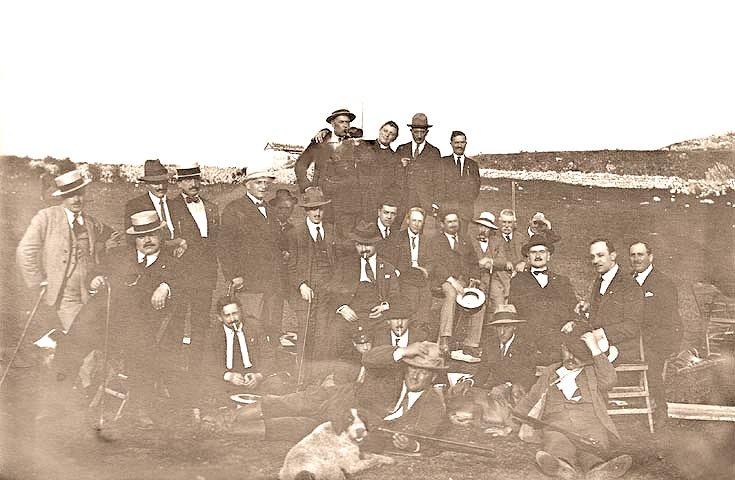
circa 1920 foto di gruppo di signori di Torricella appartenenti al Circolo della casa di Conversazione. Si riconoscono : il signore seduto sulla sedia a sinistra è Antonio Porreca Aspromonte detto “paparascianne”, il terzo in piedi sopra paparascianne e Don Michele Persichetti, il 5° è Don Alessandro Madonna, L’11° seduto sulla destra è Antonio Teti , di fidiriche. Photo of a group men from Torricella belonging to the Club of the House of Conversation. We can recognise: the man seated on the left is Antonio Porreca Aspromonte called “paparascianne”, the third person standing above paparascianne is Don Michele Persichetti, the 5th is Don Alessandro Madonna, the 11th, seated to the right, is Antonio Teti, (di fidiriche).
|
|
|
|
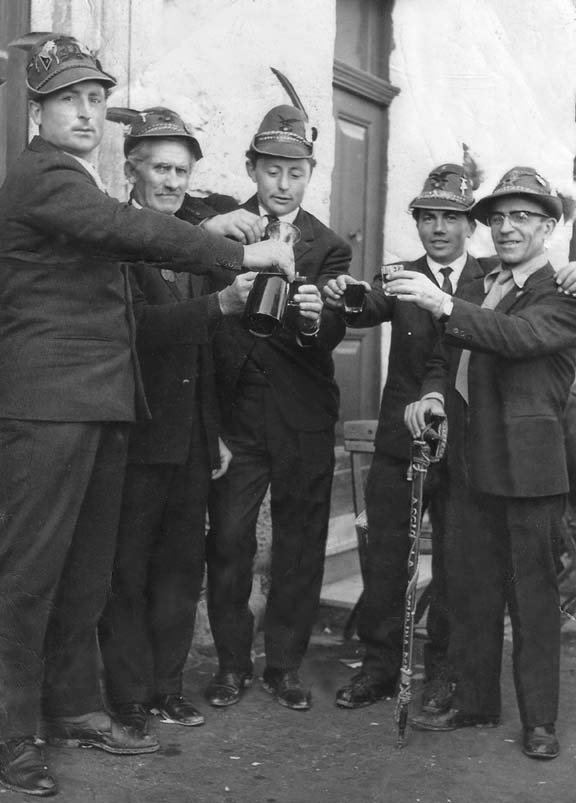
1965 Franco Di Paolo, Mariano Di Paolo, Camillo Di Paolo di centpinsieri, Vincenzo Teti di aspere, Nicola D’Ulisse di mischiarielle
|
|
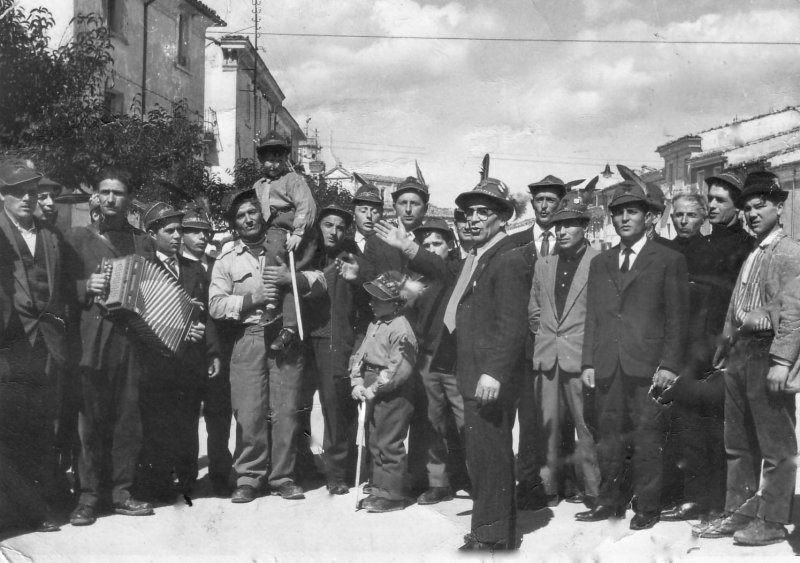
1965
Festa degli Alpini Nicola Di Loreto, Rocco Piccoli con la due botte*, Domenico Piccone, Marziale D’Amico, Francesco Antrilli , Franchino Di Luzio, Camillo Di Paolo, Franchino Di Paolo, Nicola D’Ulisse di miscarielle, Barchiesi, Guido Carapella, Domenico Evangelista, Nicola Di Paolo di siddere, Carmine Turchi di lu sorde, Gaetano Di Pentima di cecche Album: Gina di Paolo * Una piccola fisarmonica con solo due tasti dei bassi. Era molto usata per accompagnare le canzoni popolari e per suonare "il saltarello", un tipico ballo abruzzese. A small accordion with only two bass buttons. It was often used to play folk songs and the “saltarello”, a typical Abruzzese dance. |
|
|
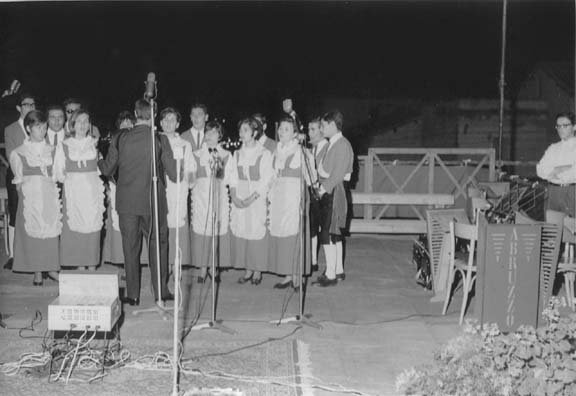
1966
Coro Folcloristico di Torricella diretto da Renzo Porreca
|
|
|
|
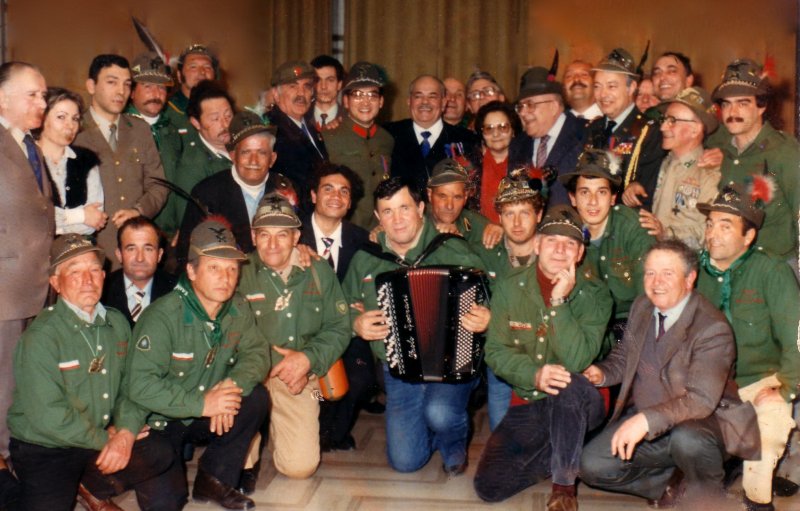
1980
Festa degli Alpini
Alla presenza del Grande invalido Biagio Rossi di Colledimacine, al centro, e dell’Onorevole Pennetta. Album: Pietro Antrilli |
|
|
|
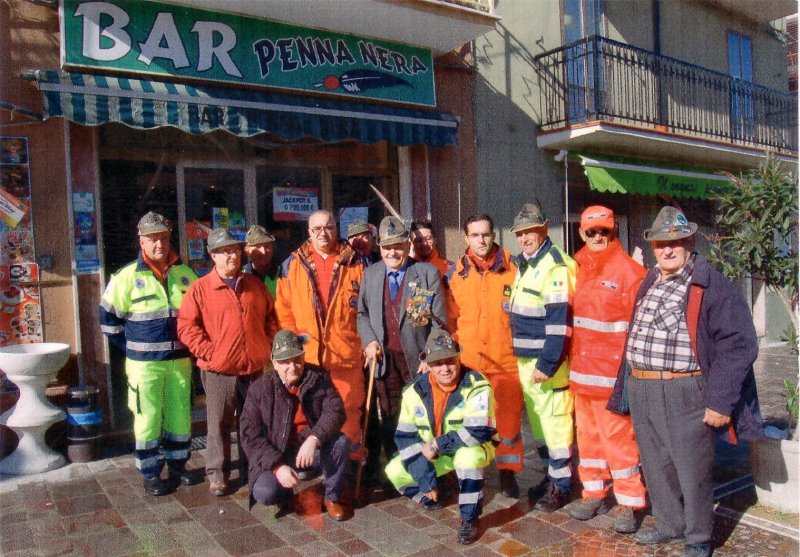
2006 *Pegaso è un’associazione di volontari con sede ad Altino (Chieti) e una sezione a Torricella. Molti degli alpini e dell'associazione Avis partecipano anche alla Pegaso. Fanno servizio di assistenza e protezione civile. Hanno anche un'ambulanza per portare i malati all'ospedale di Casoli, e la mattina fanno un servizio navetta per portare le persone anziane al poliambulatorio che sta a S. Antonio, un po’ lontano dalla piazza. *Pegaso is a volunteer association based in Altino (Chieti) with a chapter in Torricella. Many members of the Alpine Guard and Avis also belong to Pegaso. They provide civilian assistance and protection. They also operate an ambulance taking those in need to the hospital in Casoli. In the morning they run a shuttle service taking the elderly to the medical clinic in the Sant’Antonio district of Torricella, a bit of a distance from the center of town. Album: Sezione Alpini di Torricella (Alpine Guard Association of Torricela) |
|
2008 |
|
2009 |